
The Sting (1973)
Your classic fake-out triple-cross poker-cheat rigged-bookmaker long con.
CAUTION: Plot spoilers for a 53-year-old movie. ALSO CAUTION: The plot is deeply convoluted.
Before we get bogged down in the mechanics of the big con, let’s talk vibes. The Sting is ostensibly a revenge picture, but it plays like a breezy hangout film. It’s Ocean’s Eleven-esque: don’t sweat the details, just enjoy how roguish our heroes are. Especially older con man Henry Gondorff (Paul Newman), who steals the movie right out from under lead Robert Redford.
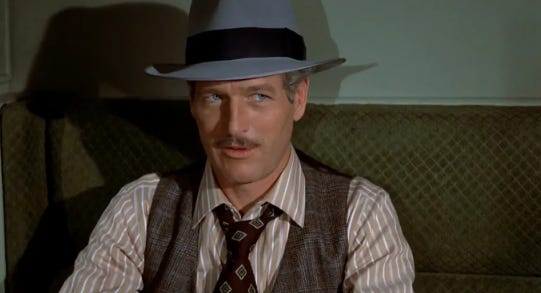
Johnny Hooker (Robert Redford) and Gondorff’s scheme unfolds in layers. First, Gondorff cheats crime boss Doyle Lonnegan (Robert Shaw) at Lonnegan’s own rigged poker game. Later, Hooker pretends he also wants revenge on Gondorff and tells Lonnegan they can rip him off at his off-track betting parlor—one that Gondorff and Hooker have built specifically for the con.
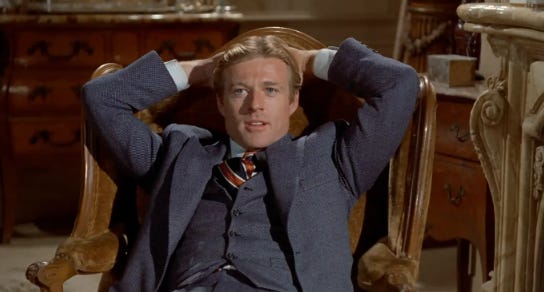
Hooker tells Lonnegan he’s got a friend at Western Union who can hold up horse racing results, allowing them to “past-post” a bet (i.e., place a bet after knowing the race’s outcome). To build Lonnegan’s confidence, they let him win on a few phony tips at their phony betting parlor before persuading him to stake $500,000 on the tip “Place it on Lucky Dan.”
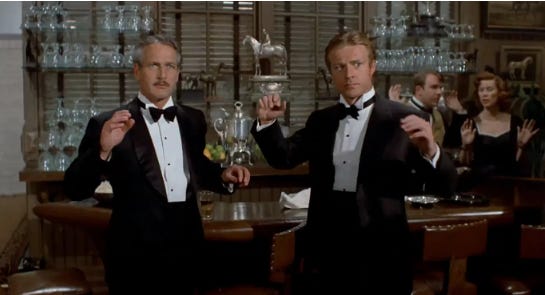
Lonnegan bets on Lucky Dan to win, then hears the bad news: Lucky Dan came in second. The tip, he learns, was to bet Lucky Dan to place (come in second). Oops. Then, to cap off the con, a fake FBI team storms the betting parlor. Gondorff “realizes” Hooker double-crossed him, pulls a gun, and shoots him, after which the fuzz gun down Gondorff. Lonnegan bolts, half a million dollars lighter and convinced both men are dead. He’s been stung, baby.
Rating: 8/10, floats like a bumblebee.
Cast and Crew
Uh-oh. This is the only Robert Redford film we’ll be watching in this series. That sounds like a mistake, right? Robert Redford? One of our all-time great movie stars? Only in one movie nominated for Best Actor? Wow. For now, let’s do a snappy “best of Robert Redford” survey here1 and cover the films more in depth in future wrap-ups.
The Way We Were (1973). It reads like a cheap Love Story knockoff and is sunk by the criminal lack of chemistry between Redford and Barbra Streisand. The film’s title song, performed by Streisand, is pretty good though.
Three Days of the Condor (1975). Half as many condor days as the novel it was based on.
All the President’s Men (1976). Redford talks on the phone for a while, figures out Watergate.
The Natural (1984). Roy Hobbs bashes baseballs, gets shot, bashes one more baseball.
Out of Africa (1985). What if The Way We Were, but in Africa? Instead of Streisand, now Redford has no chemistry with Meryl Streep.
Indecent Proposal (1993). Redford purchases Woody Harrelson’s wife for a cool million ($2.24 million in 2026 dollars).
The Horse Whisperer (1998). Redford is a horsey therapist, and I assume the climax has him telling the horsey “it’s not your fault, it’s not your fault.”2
There’s lots to like about Redford. Mostly how he looks. He looks really, really good. But he was also notable for his work behind the camera, starting with Ordinary People (1980), which won the Oscar for Best Picture.3 He followed it up with films like A River Runs Through It (1992), the aforementioned The Horse Whisperer, and The Legend of Bagger Vance (2000). But let’s highlight Quiz Show (1994), one of many films that suggest quizzing is about knowing trivia like whether Paul Revere rode a mare or a stallion. C’mon man. That’s not quizzing. Quizzing is about learning all of Robert Redford’s films by rote.
You might be realizing just how difficult it is to tell the story of American film without Bobby Red. And that’s even before we talk about him co-founding the Sundance Film Festival (named after his character from Butch Cassidy and the Sundance Kid). That is one hell of a legacy.
I said lots of good things about Redford above, right? Good. Here’s where the other shoe drops: Redford gets absolutely blown off the screen by co-star Paul Newman. Redford’s charisma is at an 8 while Newman’s is at…I don’t know, a 12? A 15? Watch the man chew scenery in this poker scene and watch a master at work. Newman might have the highest batting average of any actor we’ve seen in this column—Cat on a Hot Tin Roof, The Hustler, Hud, Cool Hand Luke. My God!
We’ll see Newman nominated for Best Actor four more times. Did he not want to share accolades with his pal Rob? Ah, whatever—we love Paul Newman in this column. We’re looking forward to an even older Newman when we catch up with him in the 1980s.
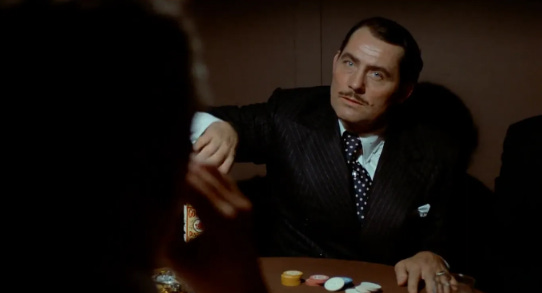
Robert Shaw played the mark, the third hand of this three-hander. We’ve seen Shaw already as Henry VIII in A Man for All Seasons and discussed his badass train fight in From Russia with Love (1963), but the man wasn’t a star. That changed once he played Quint in Jaws (1975). Unfortunately, he didn’t get to enjoy stardom for long—he died of a heart attack in 1978, aged 51.4 Though we won’t be seeing him on screen again, we will be watching The Man in the Glass Booth (1975), adapted from a play Shaw wrote. We’ll also do something special for Jaws. Ya gotta know Jaws.
Quick Hits:
The Sting reunited Redford and Newman with director George Roy Hill, with whom they had collaborated on Butch Cassidy and the Sundance Kid (1969). Beyond those two hits, Hill also directed Slap Shot (1977) and The World According to Garp (1982).
Costume designer Edith Head won her eighth and final Best Costume Design Oscar for The Sting. If you thought she could only dress beautiful women like Elizabeth Taylor and Audrey Hepburn—well, it turns out she could also dress beautiful men.
The rubber-faced Ray Walston played the con man calling the horse races. He was known for roles on TV in “My Favorite Martian” (1963–1966) and “Picket Fences” (1992–1996) and won a Tony for “Damn Yankees” (1956; here he is singing in the film adaptation). He also had a slew of film roles; one memorable to those of a certain age is Mr. Hand in Fast Times at Ridgemont High (1982).
The Trivia
From 1942 to 2000, the Oscars had two scoring awards.5 At the 1974 Oscars, those two Best Music awards were for “Original Dramatic Score” (good name) and “Scoring: Original Song Score and Adaptation -or- Scoring: Adaptation” (terrible name). Though the names of those two categories changed many, many times, they essentially were trying to disentangle “original” scores from musical or comedy scores.
In 1974, after his annus mirabilis of 1973, Marvin Hamlisch won both scoring awards. The Original Dramatic Score win was for The Way We Were, while his “yadda yadda Scoring: Adaptation” win was for The Sting. What music was that score adapted from? The first part of today’s Trivia Section: the rags of Scott Joplin.
To first order, you can just remember Scott Joplin (1868–1917) as the “King of Ragtime.” He’s best known for two songs, both used in The Sting: “The Entertainer” and “The Maple Leaf Rag.” Okay, you can go now.
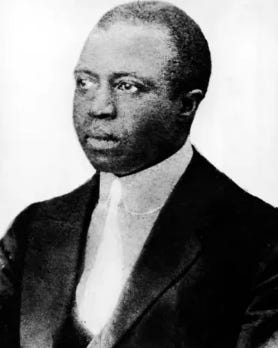
What is ragtime, though? Well, it’s a piano-based music form that evolved from the cakewalk.6 Its name comes from the “ragged” way the right-hand melody is syncopated against the steady, march-like bass played by the left hand. Its spiritual home was Sedalia, Missouri, where Joplin worked and wrote.
Though Joplin is best remembered for ragtime, he also wrote two operas. The first, which is lost, was “A Guest of Honor,” about Teddy Roosevelt’s White House dinner with Booker T. Washington. The other was “Treemonisha,” which wasn’t performed until 1972 and afterwards earned Joplin a posthumous “Special Award” Pulitzer Prize. These operas play a key role in the 1977 biopic Scott Joplin, which starred Billy Dee Williams in the title role.
You might think we’re gonna dig into Joseph Lamb and James Scott, two men who idolized Joplin and, with him, form ragtime’s “Big Three.” Or maybe you think we’re gonna talk about Joshua Rifkin, whose 1970 album “Piano Rags by Scott Joplin” sparked a ragtime revival and directly led to Hamlisch using Joplin’s music in The Sting. Naw man. That’s not what we’re doing. Instead, we’re gonna talk about Indian rag. WHAT A ZAG.
“Raga” comes from the Sanskrit root meaning “to color” or “to dye” and, to be clear, has nothing to do with ragtime. While ragtime is a style, raga is more like a mode (if modes were, like, way more complicated). Like, look at the thing below: doesn’t that sorta look like the circle of fifths?
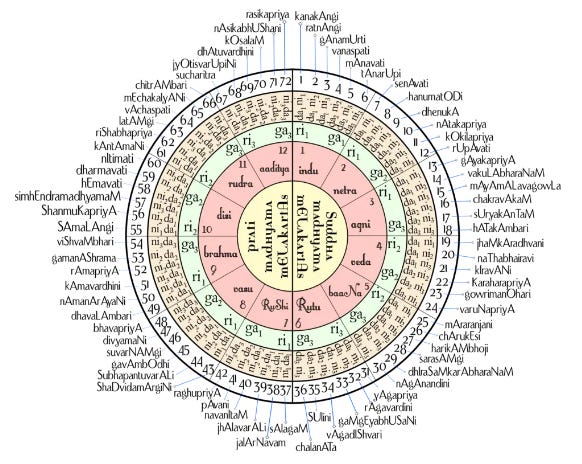
But while the circle of fifths helps you understand harmony, the raga specifically instructs you on melodic movement, ornamentation, and phrasing. Here’s a Reddit post that digs into that thing above, but mostly you’re fine just knowing the word “raga.” I guess you could know about the two main classical music traditions of India—Hindustani (North Indian) and Carnatic (South Indian)—but you’ll have to take that journey on your own.
Odds and Ends
Robert Redford also played the villain (spoiler) in Captain America: The Winter Soldier (2014)…cakewalk and ragtime became briefly popular in Europe, with Debussy writing “Golliwog’s Cakewalk”…Scott Joplin: “it’s never right to play ragtime fast”…you should be aware of the E.L. Doctorow novel “Ragtime” (1975)…“no sense in being a grifter if it’s the same as being a citizen”…the Stinger cocktail has brandy and white crème de menthe…a scene shows a revolver with a silencer on it, but this Reddit thread suggests that doesn’t usually work…James Earl Jones’ father played Luther, the mentor to Redford’s character who’s murdered at the beginning of the film…The Sting had a sequel, but it’s one of those sequels that has basically nothing to do with the original film and that everyone hates.
We’ve discussed Barefoot in the Park (1967), Butch Cassidy and the Sundance Kid (1969), The Candidate (1972), and Jeremiah Johnson (also 1972) in some of our previous wrap-ups. I guess we missed Downhill Racer (1969), about a smug skier. Also, on the subject of Barefoot in the Park: Jane Fonda and Redford reunited in two more films—The Electric Horseman (1979) and Our Souls at Night (2017).
Then there’s the next tier of Redford films—The Great Gatsby (1974), The Great Waldo Pepper (1975), Legal Eagles (1986), Sneakers (1992), Up Close and Personal (1996), All Is Lost (2013). Damn, that’s a lot of movies.
Redford also won the Oscar for Best Director. Only five other directors have won that award for their feature film debut: Delbert Mann for Marty, Jerome Robbins for West Side Story (1961), James L. Brooks for Terms of Endearment (1983), Kevin Costner for Dances With Wolves (1990), and Sam Mendes for American Beauty (1999).
He knocked out notable films like The Taking of Pelham One Two Three (1974, with Walter Matthau), Robin and Marian (1976, playing the villainous Sheriff of Nottingham opposite Sean Connery and Audrey Hepburn), Black Sunday (1977), and Force 10 from Navarone (1978).
Except, it appears, at the 1958, 1980, and 1981 Oscars, where there was only one scoring Oscar awarded. Starting with the 2000 Oscars, the only scoring Oscar awarded has been for Best Original Score.
You probably know at least one cakewalk tune: “Hello! Ma Baby.”