
The Last Detail (1973)
Jack Nicholson, now with more mustache.
You know what kind of movies are great? Road trip movies. And The Last Detail is a road trip movie, with the twist that two of the road-trippers are bringing the third to prison. On a scale of Green Book to Y Tu Mamá También, that plot is at least a Planes, Trains and Automobiles.
Eighteen-year-old seaman Meadows (Randy Quaid) was busted for trying to steal $40 and was slapped with eight years in Portsmouth Naval Prison. “Badass” Buddusky (Jack Nicholson) and “Mule” Mulhall (Otis Young) are entrusted to bring Meadows from Norfolk to Portsmouth.
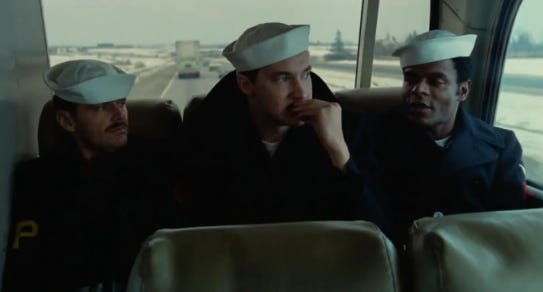
Badass recognizes that the young, passive Meadows has been railroaded and decides to cram a lifetime of experiences into their few days together. Mule also understands the unfairness but is more circumspect. He tells Badass:
I consider myself in jeopardy with you. Understand? In jeopardy. This ain’t no farewell party, and he ain’t retiring. He’s a prisoner, and we’re taking him to the jailhouse. You’re a menace, man. […] No more turning this boy’s head around to prove what a big man you are. The Navy is the best thing that ever happened to me. I don’t want you to fuck me up. You understand?
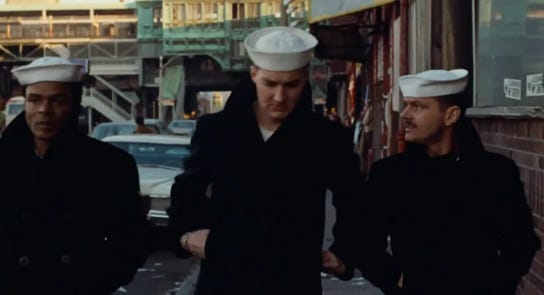
Mule is right. Regardless of all the partying, brawling, Buddhist chanting, and whoring this found family does, one of these dudes is ending up in prison. And when Meadows finally makes a run for freedom, it’s Badass who chases him down, pistol-whipping him a few times for good measure. There’s no happy ending here, no solution to the unfairness of the world: the boys do their job and Meadows ends the film in prison.1
Rating: 8/10. It’s not the destination, it’s the journey.
Cast and Crew
Jack Nicholson was the hero of the counter-culture movement. Stardom came from his supporting turn in Easy Rider (discussed in our 1969 Wrap-Up) where his character luxuriates in nihilism and solipsism. Five Easy Pieces, Carnal Knowledge (1971), and The King of Marvin Gardens (1972) refined and riffed on that “Jack Nicholson character”: intense, flawed, masculine, deeply interior, and in movies I don’t like. Maybe I’m just regular culture.2
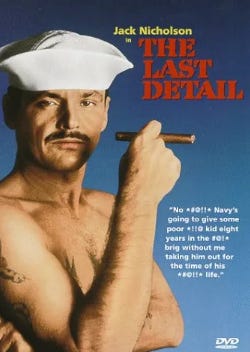
And while The Last Detail has a lot of Easy Rider in its DNA, it inverts that classic Nicholson character by putting him in a position of authority. His character is assigned to Shore Patrol, tasked with a reprehensible responsibility he nonetheless performs admirably. Even if he still acts cynical, his character is big-hearted, trying to manage within the system to do a kindness for Meadows.
Oh, and we also get one of those classic Jack Nicholson freakouts. We’ll see a lot more of those as we work our way through eight more Nicholson performances.
The Last Detail’s screenplay came from legend Robert Towne. It’s tough to tell the story of Hollywood without Robert Towne, but for trivia, I’d recommend remembering that he wrote Chinatown (1974) and Shampoo (1975). His influence went far beyond that, though: he was a famed “script doctor” who did un- or semi-credited work on a legendary list of films, including Bonnie and Clyde and The Godfather.3
Quick Hits:
Randy Quaid, who played Meadows, is Dennis Quaid’s brother. I suppose Gen X knows him best as Cousin Eddie in the National Lampoon’s Vacation movies, while Millennials know him as Russell Casse in Independence Day (1996).
Otis Young is mostly known for his role in this as Mule. Still, it’s a pretty good role, and one Jack Nicholson said was basically the first time a Black man played a real character. (Sick Sounder burn.)
The film was directed by Hal Ashby. We’ve seen his work in this column before as an editor for Norman Jewison (The Russians Are Coming, the Russians Are Coming and In the Heat of the Night). His ‘70s are blistering: Harold and Maude (1971), The Last Detail, Shampoo (1975), Bound for Glory (1976), Coming Home (1978), and Being There (1979). Three of those scored Best Actor noms and we’ve got two to go—stay tuned!
The Trivia
In the film, Buddusky is a Navy Signalman and he teaches Meadows some semaphore. One of the film’s tragedies is that Meadows shows real aptitude for it but that it’ll all be wasted. Not for you, though, since today we’re covering nautical ways of signaling.
Let’s first define semaphore: it comes from the Greek for “sign” and “bearer” and describes visual methods of transmitting messages over long distances. Old-school semaphore methods, including smoke signals, were primarily only good for providing predetermined messages. Refined forms of semaphore could be used to encode individual letters, allowing for the communication of any message.
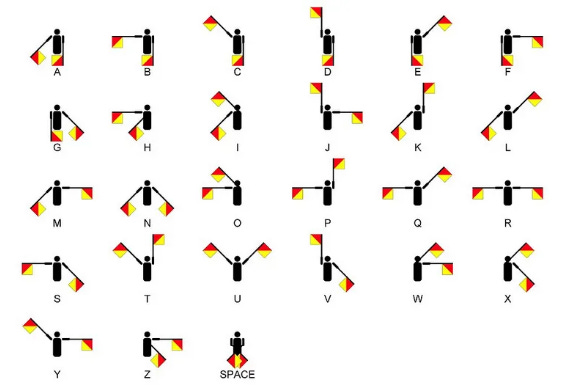
Flag semaphore uses handheld flags in different positions to represent different letters, as seen in the graphic below.
Let’s move on to signal flags, which are individual flags to display the letters A through Z. Note that, unlike the flag semaphore shown above, signal flags are all different: different cuts and colors represent individual letters.
This actually gives us an opportunity to discuss blazon, the formal vocabulary used to describe heraldic designs, which is often applied to flags as well. By the end of this section, you’ll know how to describe a flag like a real weirdo.
The descriptions of the International Code of Signals (INTERCO) follow the order of Shape → Field → Division → Charge (at least, on Wikipedia), so we’ll follow that order as well. Shape is the easiest one. Some flags are flag-shaped while others are swallowtailed. Field is also easy: it’s background color (or “tincture”) of the flag. Unfortunately, you can’t just say the color normally. You gotta say it all fancy-like using the words below.
Argent = white (silver)
Gules = red
Azure = blue
Or = yellow (gold)
Sable = black
Vert = green
Purpure = purple
So the flag below, which represents the letter “B” (Bravo), is described as being swallowtailed, gules.

Division of the field is where it gets hard. The field may be parted (“party”) in a variety of ways, some of which can be seen below.
per fess (divided horizontally)
per pale (divided vertically)
per bend (divided diagonally once)
per saltire (divided diagonally by an X)
tierced (divided into three) or quarterly (divided into four squares)
chequy (checked)
paly (divided into vertical stripes) or barry (horizontal stripes)
bendy (diagonally striped). Depending on the way the diagonal lines run, it can be either bendy sinister or bendy dexter.
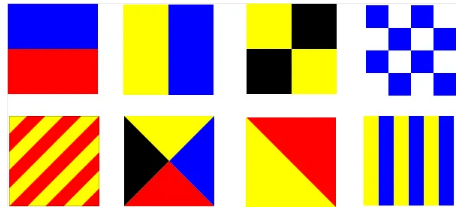
The flag may also have a charge, which is a geometric shape on the flag. These also have silly words associated with them, some of which are shown below.
Lozenge (diamond)
Cross (upright cross)
Saltire (X-cross)
Inescutcheon (square)
Roundel (circle). Note that different colored roundels have different names; the black roundel shown below is called a pellet.

Other designs include stripes of color. These stripes are defined by their color and their directionality (fess, pale, or bend).4 Those stripes can also be fimbriated, where there’s a thin contrasting outline of the color stripe. Let’s describe the flags below:
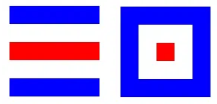
Both have blue fields. The first has a horizontal strip of red, outlined with white. In heraldry-speak, that means it is azure, a fess gules fimbriated argent. The second has a red square in the middle with a white outline. Call it azure, an inescutcheon gules fimbriated argent.
After that digression, let’s get back to semaphore. Instead of flags, sometimes you can use signal lamps that use Morse code. Morse code, invented by probably someone who wasn’t Samuel Morse, encodes letters as dots and dashes (also called di/dit and dah, respectively). In trivia, you might be asked what letter is one dot (E), one dash (T), or three dots / three dashes (S and O, as you might know from SOS). Here’s that POW who blinked “TORTURE” in Morse code—once you can do that, you’ll know you’ve mastered it.
Odds and Ends
“Heineken is the finest beer in the world and President Kennedy used to drink it”…three very famous women have small roles in this film: Nancy Allen, Gilda Radner, and Carol Kane5…the U.S. Navy disestablished the rating of Signalman in 2003…here’s a Reddit thread about how to read Braille…another important word in heraldry is chevron, which is a V-shape…“The Last Detail” novelist Darryl Ponicsan wrote a sequel, “Last Flag Flying,” which was adapted by Richard Linklater into a 2017 film…perhaps the most famous flag-encoded message was sent by Horatio Nelson before the Battle of Trafalgar: “England expects that every man will do his duty”
Badass and Mule extend Meadows one courtesy, though: when they’re asked why Meadows is wounded and if it’s because he tried to escape, they cover for him. Oh, also, the book version of “The Last Detail” has a totally different ending—after delivering Meadows, the boys go AWOL. Badass is killed and Mule ends up in prison. Yikes!
Maybe I’d like his very early-career work in Roger Corman films, including Little Shop of Horrors (1960)? Or maybe his writing is better, in films like The Trip (1967) and Head (1968)? Maybe Drive, He Said (1971), a film Jack directed, produced, and co-wrote, is the ticket? But I doubt it.
A fun Robert Towne anecdote: he wrote the script for Greystoke: The Legend of Tarzan, Lord of the Apes (1984), but didn’t like how the film turned out so he gave his dog, P. H. Vazak, the writing credit. Vazak became the first dog nominated for an Academy Award for screenwriting.
A stripe that’s thicc can be called “Spanish fess” (consider the thick horizontal stripe on the Spanish flag) or “Canadian pale” (consider the thick vertical stripe on the Canadian flag). Note that shapes can be arranged in pale, in fess, and in saltire, though that doesn’t come up in the INTERCO flags.
Very briefly: Nancy Allen was famous for her work in the films of Brian de Palma; Gilda Radner was one of the original seven members of SNL and was the wife of Gene Wilder; Carol Kane was on TV in “Taxi” (1978–1982) and “Unbreakable Kimmy Schmidt” (2015–2019).