
The Ruling Class (1972)
The power of Christ compels you.
When the 13th Earl of Gurney dies, his son Jack (Peter O’Toole) inherits his title and estate. There’s only one issue: Jack thinks he’s Jesus Christ, God of Love.
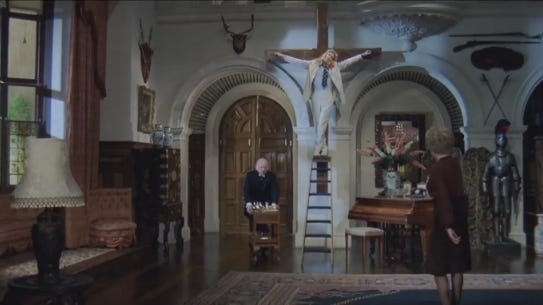
You know what Jesus loved doing? Being poor. That’s why Jack wants to give away all his family’s fortune. This doesn’t sit well with Jack’s uncle, Sir Charles (William Mervyn), who seeks to wrest control of that fortune away from Jack. Sir Charles tricks Jack into a relationship with Grace (Carolyn Seymour), intending to have Jack committed to an institution the moment he produces a male heir.
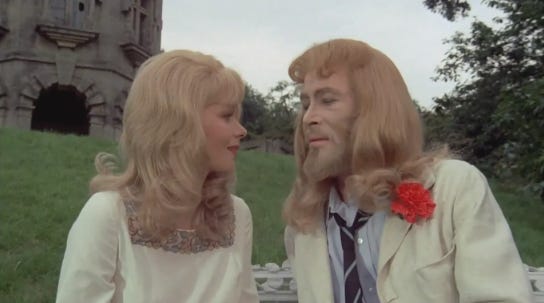
While Grace is giving birth, Jack receives electroshock therapy and is cured of believing he’s Jesus. Unfortunately, he now thinks he’s Jack the Ripper, which is why he goes and murders Sir Charles’ wife.
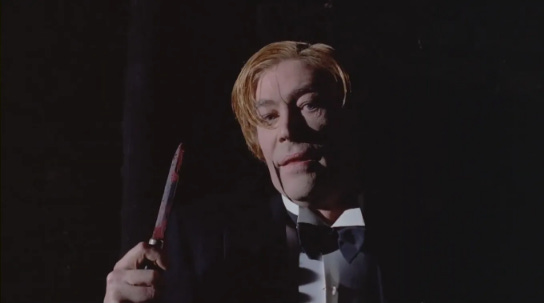
Madman Jack takes his hereditary place in the House of Lords and begins his political career with a deranged speech advocating corporal punishment. The House of Lords eats it up. Then Jack goes home and murders Grace, the end.
Rating: 8/10. “The strong must manipulate the weak! That’s the first law of the universe!”
Cast and Crew
Nobody does “erudite but crazy” like Peter O’Toole. He’s great as “defiant” in Lawrence of Arabia and “prim” in Goodbye, Mr. Chips, but give me the off-the-wall performances of The Ruling Class, Becket and The Lion in Winter any day. In this section, let’s talk about two of O’Toole’s lesser works: Under Milk Wood and Man of La Mancha (both 1972).
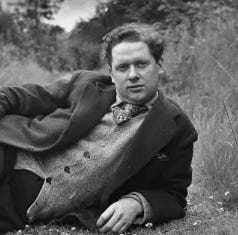
The baffling, impressionistic Under Milk Wood is based on a radio play (sometimes called a “play for voices”) by poet Dylan Thomas from 1953. In it, an omniscient narrator discusses the dreams of the residents of the Welsh town of Llareggub (“bugger all” backwards). O’Toole plays Captain Cat, a sea captain going blind, while Thomas’ fellow Welshman, Richard Burton, provides the film’s narration.
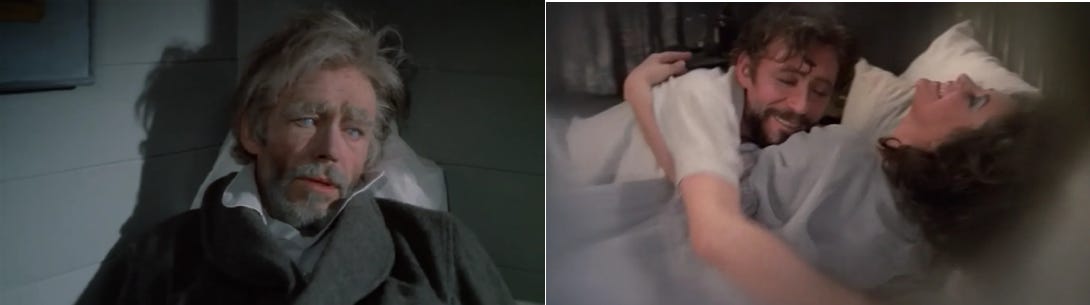
If you don’t totally get what I meant when I called Under Milk Wood “impressionistic,” take a gander at some of Dylan Thomas’ poetry. Here’s “Fern Hill,” which is about being young, I think? But mostly it’s just imagery and rhythm, as you can see below:
Nothing I cared, in the lamb white days, that time would take me
Up to the swallow thronged loft by the shadow of my hand,
In the moon that is always rising,
Nor that riding to sleep
I should hear him fly with the high fields
And wake to the farm forever fled from the childless land.
Oh as I was young and easy in the mercy of his means,
Time held me green and dying
Though I sang in my chains like the sea.
What? But also, cool.
Thomas made a mark in the poetry world before WWII1, but it was during and after the war that he became a celebrity. Thomas worked for the BBC, first scripting propaganda films and then promoting poetry through readings and criticism. He also wrote striking war poetry like “A Refusal to Mourn the Death, by Fire, of a Child in London,” from his collection “Deaths and Entrances.”
But Thomas’ best-remembered work is the villanelle “Do Not Go Gentle into That Good Night,” written for his father who was going blind. Unlike some of the poetry highlighted above, it’s pretty straightforward, with lines like “Rage, rage against the dying of the light.”
Let’s have some fun: here are two musical references to Dylan Thomas, one highbrow and one, uh, less highbrow. After Thomas’ death, Igor Stravinsky wrote “In Memoriam Dylan Thomas 1954,” a cantata based on “Do Not Go Gentle into That Good Night.” And today’s version of Igor Stravinsky, Taylor Swift, called The 1975’s frontman, Matty Healy, “not Dylan Thomas” on “The Tortured Poets Department.”
Back to talking about Peter O’Toole, sorta. As mentioned, in 1972, O’Toole starred in Man of La Mancha. It was based on a 1965 Tony-winning Broadway musical and is structured as a play within a play. O’Toole played author Miguel de Cervantes, who is arrested and, while awaiting his trial by the Inquisition, puts on and stars in a rendition of “Don Quixote” with his fellow prisoners.
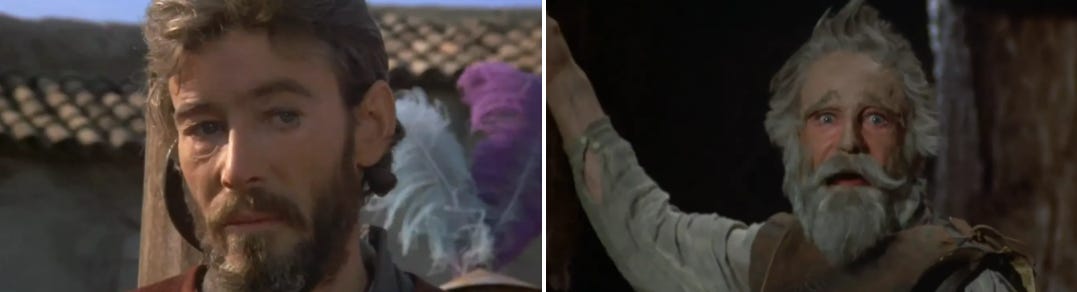
If you don’t know the plot of Don Quixote—well, that’s what we’re here for. An hidalgo2 named Alonso Quijano goes nuts from reading too many chivalric romances, renames himself “Don Quixote de la Mancha” and sets off to become a knight-errant with his “squire” Sancho Panza. His love interest is Aldonza (played by Sophia Loren in the film), who he renames Dulcinea del Toboso. Quixote famously tilts at windmills, which you can see in this scene where he, uh, loses a fight to said windmill.
Don Quixote’s doctor, Sanson Carrasco, seeks to disabuse his patient of his delusions. He disguises himself as the Knight of Mirrors and defeats Don Quixote in battle. Recovering back at home, Quixote acknowledges himself as Alonso Quijano and then dies.
The musical is best known for the song “The Impossible Dream,” though the version from the film is kinda bad. And, though O’Toole was dubbed, Sophia Loren followed in the grand tradition of Marlon Brando in Guys and Dolls and did her own disastrous caterwauling. This was one of many reasons the film was a box-office bomb.
You might have noticed that the only person we highlighted in today’s Cast and Crew section was Peter O’Toole. That’s because not a single other top-line person from The Ruling Class has been mentioned on “Jeopardy!” or in the Quiz Bowl archive. That doesn’t mean they don’t matter, but it does mean we’re gonna have discursions on Dylan Thomas and “Don Quixote” instead.
The Trivia
As Jack ends the film seated in the House of Lords, I thought “House of Lords” might make for an interesting Trivia section (for those of us who don’t live in England, I guess3). I was wrong: it’s a bad topic. But one interesting [sic] thing I learned while drafting that post is that the House of Lords was abolished by Oliver Cromwell in 1649. And that’s when I thought, oh hey, the English Civil War would make a much better topic. (Again, unless you’re English, in which case, sorry.)
Unfortunately, the English Civil War4 was long and deeply confusing (unlike the U.S. Civil War, which was short and extremely straightforward5). Broadly, it was about royal power vs. Parliamentary power. King Charles I believed he had the divine monarchical right to do whatever the hell he wanted. Parliament disagreed, and the Long Parliament (1640–1660) tried to limit his powers.6 In 1641, under the leadership of John Pym, they passed the Grand Remonstrance, a list of grievances they had with the king.7
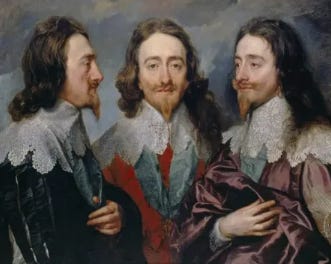
The battle lines were drawn: on one side were the Royalists (“Cavaliers”). On the other side were the Parliamentarians (“Roundheads”). And I literally mean “battle lines”: Charles raised an army to oppose Parliament, while Parliament built the New Model Army—a professional fighting force led by Thomas Fairfax and Oliver Cromwell.
Then there’s the “war” part, which is boring. The Royalists were decisively defeated at Naseby (1645), leading to Charles’ surrender in 1646. Did you think losing a war would bring Charles, a heaven-ordained monarch, to the negotiating table? Nope! Instead, Charles allied with Scottish Presbyterians and restarted the war, this time getting defeated at Preston (1648).
Charles had lost two straight wars but still maintained political power. To break that power, the military rid Parliament of its moderate members during Pride’s Purge. This left the radical Rump Parliament, which tried Charles I for treason and executed him (told you not to get attached).
With the king dead, England became a Commonwealth. Parliament now pushed for real reforms to guarantee the liberties of the people, but our guy Oliver Cromwell didn’t want that. He wanted power all for himself. Hence, he disbanded the Rump Parliament in 1653 and declared himself Lord Protector, kicking off the period in England’s history known as the Protectorate.
Oliver Cromwell died in 1658 and his son, Richard Cromwell, became Lord Protector. Young Cromwell was bad at this job, mishandling both Parliament and the army, so England decided to take a mulligan on the past twenty years. A Royalist Parliament stated that Charles II, the son of the executed king, had actually been the monarch since 1649, and Charles II came back from exile to claim the throne. All things considered, he was pretty chill about everything: he even gave the Declaration of Breda, which was a pardon for all crimes committed during the English Civil War.
So we did twenty years of war just to get back to where we started. Cool.
Odds and Ends
The Ruling Class was based on a play by Peter Barnes…the film featured the Royal Society of St George, which is some English patriotic society established in 1894…many of the radical principles of the Rump Parliament were echoed in the American Revolution a hundred years later…the eleven-year no-king period in British history is called the Interregnum…the right-leaning Tories and left-leaning Whigs trace their origins back to the Cavaliers and Roundheads, respectively…“Man of La Mancha” won the 1966 Best Musical Tony and lead Richard Kiley won the Tony for Best Actor in a Musical…Don Quixote renamed his horse Rocinante; Sancho Panza rode a donkey called Rucio…Dylan Thomas also wrote the story “A Child’s Christmas in Wales,” which you can listen to him read here…The Ruling Class uses “The Stripper,” a song you definitely know, as a clever needle drop.
It’s kind of interesting that, in 1972, Peter O’Toole played two different roles about men filled with delusions of grandeur—Don Quixote, who believed himself a knight, and The Ruling Class’s Jack, who literally thought he was Jesus. But that’s fine, he’s good at that sort of thing.
Thomas’ first two collections, “18 Poems” and “Twenty-Five Poems,” contain poems that are dense, but not in the annoying way of contemporaneous symbolist poets like W. H. Auden and Ezra Pound. Some of his early poems include “The force that through the green fuse drives the flower“ (considered the poem that made Thomas famous) and “And death shall have no dominion.” He also wrote a collection of short stories called “Portrait of the Artist as a Young Dog.”
This just means “nobleman.” You can see that word in the original title of the work: “El ingenioso hidalgo Don Quijote de la Mancha.”
Being from the U.S., I’d certainly think it was boring reading a section about how, like, each U.S. state gets two senators or whatever. But here’s some fun stuff: I was in a bar in Mississippi a few years ago and listened to a woman give a jeremiad on repealing the 17th amendment (that’s the one granting direct election of senators). Well, first, why’d we even need the 17th amendement? Here’s why: the framers of the Constitution figured that one popularly-elected branch (the House) was more than enough popular representation for the people. But during the early 1900s, Progressives sought to break the power of the political machines that controlled state legislatures (who elected senators). This culminated in the 17th amendment. So why should we get rid of it? Not sure, but this site discusses it in detail.
The English Civil War was actually a subset of a longer conflict called the Wars of the Three Kingdoms (referring to Ireland, Scotland, and England), which sounds like something from Game of Thrones. Scotland and Ireland lost those wars, and at the end, England was in control of all the British Isles for the first time in history.
It was about slavery. That same chick from that bar in Mississippi vigorously argued that the U.S. Civil War wasn’t actually about slavery, but c’mon. Arguing that it was about states’ rights—as in, the right to have slaves—feels like a distinction without a difference.
In 1629, Charles had dissolved Parliament and ruled with absolute power. This was fine as long as he didn’t need money for war. Of course, then he started a war and did need money, so he called Parliament back in 1640. This “Short Parliament” lasted only three weeks and didn’t give him the money so Charles dissolved it. The Long Parliament, which was called with the stipulation that it could only be dissolved with the agreement of its members, lasted…well, a lot longer than the Short Parliament.
Because all roads lead back to religion in the English world post-Henry VIII, one of Parliament’s biggest concerns was bishops in the Church of England and that Charles’ wife, Henrietta Maria, was French Catholic.
When I was in film school, I befriended sitcom director/The Bob Newhart Show cast member Peter Bonerz. One afternoon, my then-girlfriend and I had a three-hour lunch at the Farmers Market LA with Bonerz and a guest who turned out to be Peter Medak, director of "The Ruling Class." He shared some fun stories about the alcoholism of the cast.