
Serpico (1973)
Snitches get stitches.
Ah, the age-old question: “Who can trust a cop who don’t take money?” Serpico traces the actions of New York City cop Frank Serpico (Al Pacino), a clean cop adrift in a sea of corruption. It’s like Charlie says in “It’s Always Sunny” when he’s cosplaying as Serpico:
Yeah, I get it. Everybody’s a crooked cop, huh! Am I the only cop left in Philadelphia who ain’t crooked?! Oh, oh, I see what’s happening. You wanna come at Serpico, huh? Who wants a piece of Serpico?
Is Serpico’s biggest legacy this 20-year-old episode of TV? I mean…yeah, I think so. Well, that and Al Pacino’s protean facial hair.
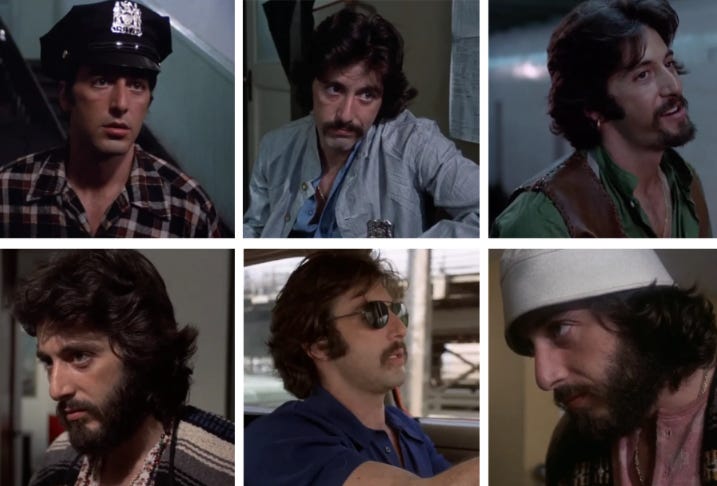
The facial hair is actually key to the story: it reflects Serpico’s desire to look like and connect with the community he’s serving. It’s also a physical reminder of how different Serpico is from the other “black shoes and white socks” cops.
Serpico snitches on the dirty cops again and again but gets nothing for it but a target on his back. It’s only when he takes the story to the New York Times that there’s any real institutional change.1 But the movie is mostly about the consequences of Serpico’s actions: the fight impacts his work, his relationships, and his mental health—plus he gets shot in the face on a bust when his partners don’t back him up. Though he recovers and sees his bravery lead to reforms in the department, the viewer is forced to ask: was it worth it?
Rating: 7/10. “The cost of honesty is martyrdom.”2
Cast and Crew
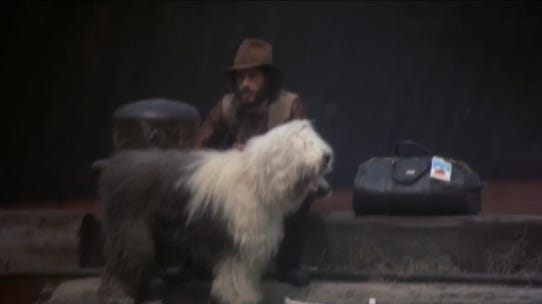
Al Pacino came up through the Actors Studio and broke out in The Godfather. Watching Serpico on the heels of The Godfather helps to show his impressive range. The difference in the characters he plays is deeper than “Michael Corleone is robber, Frank Serpico is cop.” Michael is characterized by his stillness, his control, his cunning. Serpico, on the other hand, is guileless: he can barely articulate why he won’t take dirty money or why he’s waging this self-destructive fight against crooked cops. He’s also a warm guy who loves the richness of life. Like, look at him and this big dog! Can you imagine Michael Corleone with a big dog??
Also, heads up, The Godfather Part II is really good. More on that in a few weeks.
What is the price of genius for a director? Is it perfectionism, damn the schedule or budget? Is it torturing your actors to get what you want? Is it making a bunch of terrible movies to distinguish the singularity of your best movies? Is it a distractingly mannered but immediately recognizable visual style? Is all of this why we don’t talk about Sidney Lumet like he’s a genius? To steal a phrase from Bill James about Donnie Baseball: Lumet is 100% director, 0% bullshit.
Lumet was known as an “actor’s director,” and his films garnered many Best Actor Oscar nominations for his leads. Often, these films focused on heroes or antiheroes who live by their own moral code, defy authority, and suffer for it. I just gobble that stuff up and it’s why I think many of Lumet’s films—including 12 Angry Men (1957) and the upcoming Dog Day Afternoon (1975) and Network (1976)—hit so good.
We last saw Lumet’s work in 1964’s The Pawnbroker. In the decade between The Pawnbroker and Serpico, Lumet directed at least one movie a year. While these movies are at worst functional (The Anderson Tapes, 1971) and at best pretty good (The Deadly Affair, 1967), they’re not well-remembered and are therefore out of the scope of this newsletter.
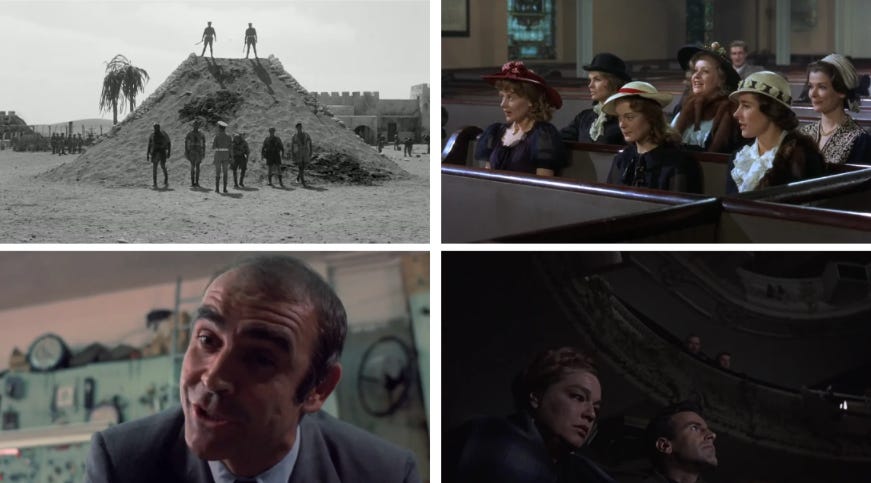
You might have noticed Sean Connery’s face in one of the pictures above—he actually made five films with Lumet. We’ll be watching one of them in 1974.
The Trivia
In Serpico, Serpico and his girlfriend go to see the American Ballet Theatre.3 I thought it might be fun to cover the ballets the ABT is staging as part of their spring season, but, uh…they’re kinda esoteric. Our mission statement is to discuss the Trivia Canon, so today, let’s just start with a simple ballet primer. And, bro, you need it—check the J! Archive database, where over 1,000 questions mention ballet. What appears below should answer, like, most of them. Note that nothing in this section is bolded: that’s because I actually think you need to know every proper noun in this thing.
Let’s start with ballet companies. There are two Russian ones you should be aware of. One is the Bolshoi, with a name that means “great” in Russian. The other is the Mariinsky Ballet, though it has gone through some name changes: it was once known as the Russian Imperial Ballet and was later renamed the Kirov Ballet after an assassinated Soviet politician.
Another ballet company to know is the Ballets Russes, which, despite its name, was not a Russian ballet company. It was created by Sergei Diaghilev—an important ballet guy who wasn’t a dancer, composer, or choreographer— and, despite only existing from 1909 to 1929, it was hugely influential because of the artists it commissioned works from.
Here are three more companies that are famous for being led by impresarios:
Alvin Ailey American Dance Theater. This one was founded by namesake choreographer and dancer Alvin Ailey and is (per its website) renowned for performances that uplift the African American experience. It wouldn’t hurt to know a couple of Ailey ballets—say, “Revelations” and “The River.”
The Joffrey Ballet, which was named for founder Robert Joffrey and not co-founder Gerald Arpino. It was originally in New York but is now based in Chicago. Its website doesn’t say anything about the African American experience.
New York City Ballet. This one was founded by choreographer George Balanchine. While the ABT does more “classical” ballet, the NYCB is more modern. It is known for doing Balanchine’s version of “The Nutcracker” at Christmas.
Okay, those were the seven4 companies you should have a working knowledge of, and we haven’t even started to talk about ballet yet. Don’t worry: we’re doing composers now and their most famous works.
First: if you’re asked about a composer associated with ballet, your first thought should be Pyotr Ilyich Tchaikovsky (1840–1893). You’re responsible for knowing three of his major works, along with the name Marius Petipa, one of his main choreographers.5
“The Sleeping Beauty” (1890): You know this from the Disney version, though the wicked fairy in the ballet is named Carabosse, not Maleficent.
“The Nutcracker” (1892): An adaptation of an Alexandre Dumas story, which itself was an adaptation of “The Nutcracker and the Mouse King” by E. T. A. Hoffmann. The story: Clara, daughter of Dr. Stahlbaum, is playing with the new toy her godfather Drosselmeyer has gotten her: a nutcracker. Her stupid brother Fritz breaks it but then it…uh…comes to life? to lead an army against the seven-headed Mouse King? and then it transforms into a prince and they all go to the Land of Sweets, ruled by the Sugar Plum Fairy? What???
“Swan Lake” (1895 revival). Yeah, it’s probably just easiest to learn this from the film Black Swan (2010). Know Prince Siegfried, who usually drowns himself in the title lake, along with the characters Odette and Odile, who are by tradition played by the same dancer.
For more trivia-focused details on these ballets (and the ones mentioned below), you can check out the NAQT You Gotta Know Ballet Part 1 and Part 2. Their posts tend to be less snarky than mine.
After Tchaikovsky, the next-most famous ballet composer is Igor Stravinsky (1882–1971). He’s also got three6 biggies to know, and all three were written for Diaghilev’s Ballets Russes company.
“The Firebird” (1910). From Wikipedia: “The Pontiac Firebird is an American automobile [that was] designed as a pony car to compete with the Ford Mustang.”

“Petrushka” (1911). It’s about a tragic puppet.
“The Rite of Spring” (1913). Not gonna try to explain the plot of this one either. Know the ballet’s subtitle (“Pictures of Pagan Russia”) and its two parts (“The Adoration of the Earth” and “The Sacrifice”).
Michael Fokine choreographed those first two while Vaslav Nijinsky did the final one. Nijinsky’s choreography may have been why there was a riot-ish thing at the premiere of “The Rite of Spring.”
Two other Russian ballet composers of note: Sergei Prokofiev (1891–1953), known for “Romeo and Juliet” and “Cinderella,” both of which have plots you can surmise; Nikolai Rimsky-Korsakov (1844–1908), whose Arabian Nights-based “Scheherazade” you should know.
And I’d be remiss if I didn’t include my mother’s favorite trivia question: What ballet will give you the “Wilis”? The answer, besides the obvious (“all of them”) is “Giselle” (1841); the Wilis are vengeful ghost maidens.
The rabbit hole obviously continues from there, but ten ballets is enough.7 For good measure, let’s add in a handful of dancers you should know.
Anna Pavlova (1881–1931). Her best-known piece was “The Dying Swan,” a solo piece choreographed for her by Michael Fokine. It uses the music from Camille Saint-Saëns’ “Carnival of the Animals,” and despite it being from over a hundred years ago, you can see a recording of her performance here.8
Vaslav Nijinsky (1889–1950): He was considered the greatest male dancer of his time, though mental illness ended his career early. He was also a choreographer for Diaghilev and did “Afternoon of a Faun” and (as mentioned) “The Rite of Spring.”
Rudolf Nureyev (1938–1993). He was a big-shot Russian dancer who defected to the West. He was famed for dancing with Margot Fonteyn, prima ballerina assoluta of the Royal Ballet.
Mikhail Baryshnikov (b. 1948). Born in Latvia, he defected to Canada in 1974. This unfortunately means your Pavlov for Russian ballet boys can’t just be “defected.”9 For us lowbrow slobs, Baryshnikov may be better known as an actor; you may remember him as one of Carrie Bradshaw’s boyfriends on “Sex and the City.”
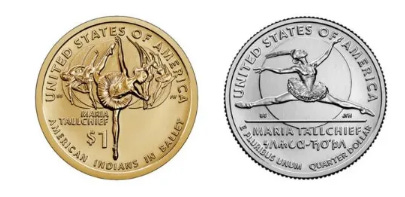
Sometimes your Pavlov will just be the dancer’s ethnicity. Maria Tallchief (1925–2013) was a Native American dancer who was married to George Balanchine (remember? the NYCB guy?). She was one of the “Five Moons,” five Native ballet dancers born in Oklahoma.
Aaaand if your Pavlov is “African American dancer,” then Misty Copeland (b. 1982) is probably your answer. Specifically, she was the first African American principal dancer for the ABT. She’s also lots more than that.
Odds and Ends
Serpico was apparently novel for showing police corruption in a film…the film was based on a book by Peter Maas…there were later “Ballet Russes” companies with the name “de Monte-Carlo” tacked on…I didn’t fit in many modern choreographers above, but these ones are important: Jerome Robbins (gotta know “Fancy Free”), Martha Graham (gotta know “Appalachian Spring”), Agnes DeMille (gotta know “Rodeo”)…there’s a ballet called “La Sylphide,” remember that one too…Serpico was produced by big-deal producer Dino De Laurentiis, grandfather of Giada De Laurentiis.
One last thing: here’s “New York City Cops” by the Strokes. New York City cops: they ain’t too smaaaaaht.
Wait, was this whole story about the failure of institutions and the value of a free and independent press that can hold sources of power accountable? Ah, the halcyon days of newspapers. Now the only way to hold someone accountable is when someone else with clout doxxes them on Twitter. I’m worried things might be bad now.
Real-life cop David Durk, one of the two cops (along with Frank Serpico) that this story is based on, has said that Serpico (the film) made honesty seem like martyrdom. Yes, this was intended as a criticism of the film.
Serpico is later spotted reading Isadora Duncan’s biography, “My Life.” Duncan (1877–1927) was a dancer and choreographer, but unfortunately, the thing she’s most remembered for is her scarf-related death.
And, uh…here are two more: The Royal Ballet (British, housed in Covent Garden); the Paris Opera (both the primary opera and ballet company of France; founded by Louis XIV).
Yeah, yeah, Lev Ivanov also played a major role in the choreography, but c’mon man, this is Ballet 101.
Apologies if you wanted to talk about Stravinsky’s “Pulcinella” (1920) or whatever, we’re not doing that.
I mean, maybe you want Léo Delibes’ “Coppélia,” about a man infatuated with a doll. Or maybe “Gayane” (1942) by Armenian composer Aram Khachaturian, which contains the “Sabre Dance.”
Was she the best dancer? Wikipedia says a lot of negative things about her technique—but maybe technique is for chumps. A big part of her fame stemmed from the fact that she formed her own company and performed throughout the world. She became so famous that she got a dessert—the Pavlova—named for her.
In fact, there’s another reasonably well-known ballet defector: Alexander Godunov (1949–1995), who came to the U.S. in 1979. He was partnered with actress Jacqueline Bisset and had roles in films, including Witness (1985) and Die Hard (1988).
You know, there's also an NAQT You Gotta Know about choreographers: https://www.naqt.com/you-gotta-know/choreographers.html
You might even recognize the name of the author!