
Last Tango in Paris (1973)
The butter movie.
Paul (Marlon Brando) and the young Jeanne (Maria Schneider) meet while viewing an apartment for rent—then wham, they’re having sex. That kicks off three days of NSA hookups, with Paul insisting they stay virtual strangers, withholding even their names from each other. Here’s Paul’s pitch:
Don’t you see? We’re gonna forget everything that we knew, every—all the people, all, all that we do, all that we…wherever we live, we’re gonna forget that, everything, everything.
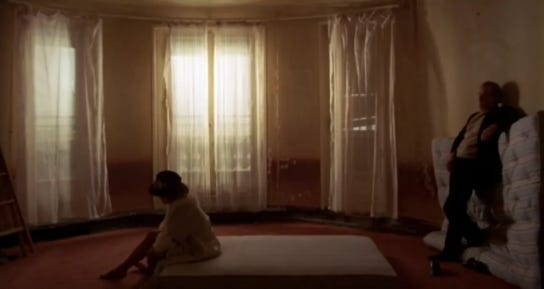
The random sex shelters the pair from their lives outside the apartment. Paul is coping with the fallout from his wife’s suicide, while Jeanne is managing her relationship with her filmmaker boyfriend Thomas (Jean-Pierre Léaud).
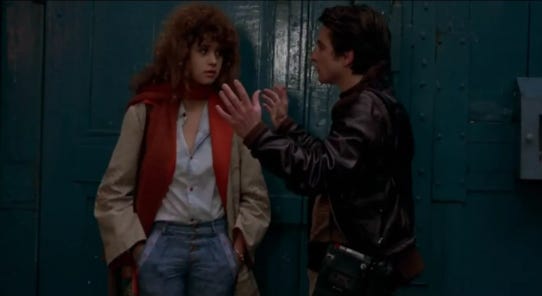
Why does Jeanne keep going back to see Paul? Paul gives her nothing; she asks him, “why do I feel like I’m talking to a brick wall when I talk to you?” And that’s the best-case scenario. In the scene the film is most infamous for, Paul anally rapes Jeanne, using butter as lubricant.
It’s Paul who eventually breaks the rules, telling her his name and that he loves her. This is when Jeanne realizes what has been obvious to everyone watching the movie: that Paul sucks. She tries to end it with him but he chases her back to her apartment where, ostensibly in self-defense, she shoots him dead, the end.
Last Tango in Paris deals in X-rated subject matter, but the movie feels remarkably immature. It presents itself as a complex meditation on passion, but its commentary never gets above the level of Fifty Shades of Grey (2015). Is it about anything other than the sophomoric “hur dur two strangers screw”? Since the film was heavily improvised, probably not. We’ll talk about Marlon Brando at length below, but here’s a quote of his from a 1957 “New Yorker” profile:
People around me never say anything. […] They just seem to want to hear what I have to say. That’s why I do all the talking.
Brando said he poured himself into Paul, but what he had to say as that character just wasn’t all that interesting. His semi-catatonic, improvised monologues never connect him to his scene partners or to the threadbare plot, leaving the film feeling ugly and purposeless.
Of course, not everyone agrees with me.
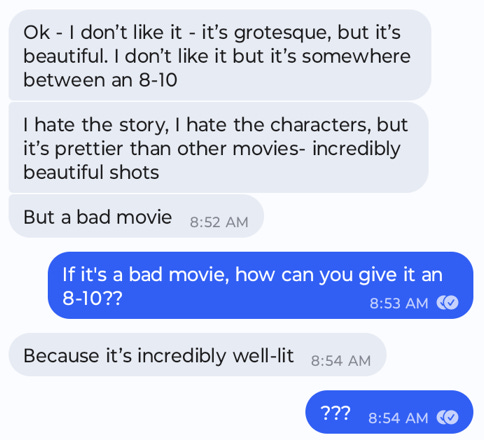
Rating: 2/10. Here’s Pauline Kael’s gushing review, which mentions that “this is a movie people will be arguing about, I think, for as long as there are movies.” That’s about the only part of her review that I agree with.
Cast and Crew
Maria Schneider is primarily remembered through the prism of Last Tango in Paris. These days, it’s not even for her performance; instead, it’s for being on the other end of the butter scene, which was sprung on her without her consent. She spoke out against the violation for decades, and the situation is discussed in this article.
I don’t like that Maria Schneider was 19 when that happened and that she had to carry it around both personally and professionally for the rest of her life. And it bums me out that my section on her is “hey, she’s the butter chick,” while the men who foisted that reputation on her are remembered in more multifaceted ways. It’d be nice if you knew even one other thing about Maria Schneider, but—sigh, for trivia—you don’t really need to.1
Marlon Brando is appearing in this column for the seventh and final time. Let’s try and give perspective to his career after his early films essentially redefined cinema acting. By the late ‘50s, he had become someone more likely to slip into self-parody than to transcend. His New York Times obituary compared him to Orson Welles: “another famous prodigy who battled Hollywood only to balloon into a cartoon version of his early brilliance.” The Times hammers his filmography from 1955 to 1970 as containing “intermittently compelling but largely unmemorable roles”2 with “more than a few outright disasters.”
One of those “outright disasters” was Mutiny on the Bounty (1962), about the HMS Bounty. The story goes that Brando was brutal to work with, the budget ballooned until it became the most expensive movie ever made, the press around it was vicious, and the movie bombed so hard that it contributed to the end of the studio system. Brando’s reviews were particularly savage: one said his performance felt as if it “is intended either as a travesty or a lark.” Upon rewatch: yep.
That’s what made his mid-career revival with The Godfather and Last Tango in Paris so surprising. But I personally disliked Brando in Last Tango in Paris, and he doubled down on a lot of his worst impulses in his next film, The Missouri Breaks (1976). This should’ve been a classic: it’s a revisionist Western with Jack Nicholson that was directed by Arthur Penn. Instead, it was a notorious critical and commercial flop, primarily from Brando’s “out-of-control,” wildly improvised performance.
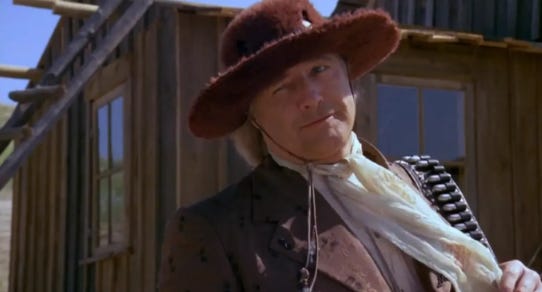
While The Missouri Breaks was a catastrophe, his final films of the 1970s were pretty good. Those include top billing for his brief role in Superman (1978) as Superman’s father, Jor-El; Col. Kurtz in Coppola’s Apocalypse Now (1979); and an evil oil exec (that’s redundant) in The Formula (1980).
Brando retired, then unretired to play a supporting role in A Dry White Season (1989), which scored him an Oscar nom. But it’s hard to go out on top. His comedy The Freshman (1990), where he played a Don Corleone-type, was well received, but lots of his final films—especially the calamitous The Island of Dr. Moreau (1996)—reinforced the caricature of Brando (cue card Brando, fat Brando, stupid costumes and accent Brando) rather than reminding us of the incendiary force he once was.
Brando is ranked #4 on the AFI “100 Years…100 Stars” list. That’s an aggressive listing for a guy whose career really boils down to four performances. I guess we’re supposed to forget all the films he phoned in or torpedoed, since his legend and his influence outweighs his, uh, inconsistent body of work. I really liked The Godfather, at least.
Let’s talk about artist Francis Bacon (1909–1992), whose works are shown over the opening credits of Last Tango in Paris. Those paintings are “Double Portrait of Lucian Freud3 and Frank Auerbach” and “Study for a Portrait of Isabel Rawsthorne.”
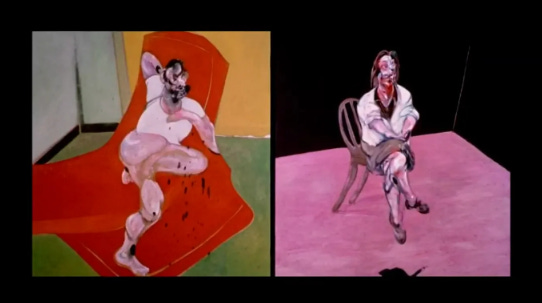
These pictures are read as reflecting the twin threads of sexuality and hideousness that run through the film. Sure thing, bud. But that’s not what we’re here for. What do you have to know about Francis Bacon for trivia? He’s known for diptychs and triptychs (two- and three-panel artworks). He painted what the Guggenheim describes as “idiosyncratic versions of the crucifixion.” And, most famously, he painted screaming popes, inspired by Velázquez’s “Portrait of Pope Innocent X.”
Note that this is a different Francis Bacon from the English philosopher Francis Bacon (1561–1626), who was Lord Chancellor under James I. That Bacon was known as the “father of empiricism” and pioneered inductive reasoning in 1620’s “Novum Organum.”4 Also, he might have written Shakespeare’s plays, though he probably didn’t (but, y’know, maybe he did).
Quick Hits:
Jean-Pierre Léaud is best known for playing little French boy Antoine Doinel in five films by François Truffaut, beginning with The 400 Blows (1959). When your major acting debut is in one of the defining films of a movement (here, French New Wave), that’ll be how you’re remembered.
French director Agnès Varda wrote some of the French dialogue for the film. Varda directed four films on the They Shoot Pictures, Don’t They? Top 1,000 list, including Le bonheur (1965) and Vagabond (1985), both of which showed up in OQL last season. (I guessed Cleo from 5 to 7 for both questions because I don’t actually know anything about anything.)
The Trivia
Sigh. Let’s talk about director Bernardo Bertolucci. I may have seemed uncharitable to Marlon Brando above, but really it’s Bertolucci’s doorstep that I should lay all my complaints about Last Tango in Paris. But let’s start with the good: this guy’s films have remarkable atmosphere. Often working with cinematographer Vittorio Storaro5, Bertolucci’s films are sumptuous in their use of set, costume, and color. This appears to be enough to land four of his films on the TSPDT list. Last Tango in Paris is one; let’s talk about the other three.
The Conformist (1970): an elevated thriller about an Italian mid-level fascist traveling to France to assassinate his former professor.6 Although I am that Netflix viewer who needs the plot repeated three times, I did figure out the theme of this film: conformity during an abnormal time doesn’t make you normal. Gotcha. I wonder if that message is relevant today.
1900 (1976): this movie is over five hours and it leans into some of Bertolucci’s worst edgelord tendencies. But when the movie isn’t muddled down in child penises and feces, we get a grand story of fascism vs. collectivist agrarianism. Also, the cast slaps—Robert De Niro! Gérard Depardieu! Burt Lancaster!!
And now, what I presume Bertolucci is best remembered for: the Best Picture-winning film The Last Emperor (1987). See, this is what’s up: take Bertolucci, a guy with immaculate aesthetic sensibilities and the ability to tell epic stories, and give him a PG-13 guardrail to make sure he doesn’t sabotage the film with child penises (though, uh, he does sneak in one child penis). The film tells the story of Puyi, the last emperor of China, who lives in the Forbidden City but leaves after the revolution to become a puppet emperor in Manchuria under the Japanese.
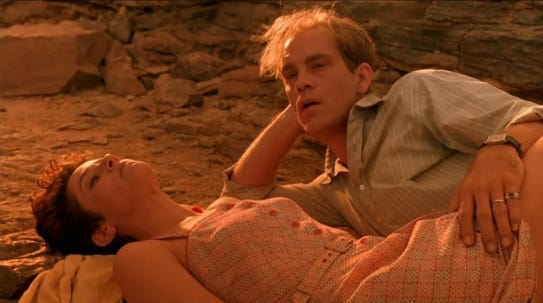
Let’s look at one more Bertolucci film: the nearly unwatchable The Sheltering Sky (1990). This one, based on a novel by Paul Bowles, is overbearing and faux-philosophical. A married couple, played by Debra Winger and John Malkovich, travel to Africa and discover the Sahara desert as a symbol of the vast gulf between them. There’s nudity and death, but in sum it’s only, to quote this review, “excruciatingly monotonous and ponderously enigmatic.”
So what have we learned? Bertolucci is a blunt filmmaker with arresting sensibilities. His best films are anchored by driving plots and characters with clear motivations. The beauty in his films—like Puyi reentering the Forbidden City as an old man—can make your breath catch in your throat. This whole section could have just been stunning stills from his films; I’d recommend this video (SFW, surprisingly) that shows a bunch of them. But his worst trait is mistaking taboo for profundity. The steady prurience of his films feels immature and boring, never crucial to the story or the characters.
Odds and Ends
Here’s Brando’s best monologue of the film, which he delivers to his dead wife…speaking to his dead wife, he says she’s “fake Ophelia, drowned in the bathtub”; you can learn about Ophelia from Taylor Swift…that 1957 “New Yorker” profile quoted above was written by Truman Capote…the movie was originally about two men, and yeah, that makes more sense…Brando wrote the memoir “Songs My Mother Taught Me”…Bertolucci’s director mentor was fellow Italian Pier Paolo Pasolini…some of the Bertolucci films I skipped out on were Luna (1979), Stealing Beauty (1996), The Dreamers (2003), and Me and You (2012).
Were you disappointed that our Trivia Section was basically an extension of the Cast and Crew Section? Do you want bonus trivia? Well, in Last Tango in Paris, Jeanne’s father is said to have died fighting in Algeria in 1958. That conflict, which stretched from 1954 to 1962, saw the National Liberation Front (FLN) fighting a guerrilla war against the French, leading to the fall of France’s Fourth Republic and the ascension of Charles de Gaulle and his Fifth Republic. For France, losing Algeria—which was legally classified as an integral part of France—was such a big deal that the Organisation armée secrète (OAS), a straight-up terrorist group founded during the war to attack both Algerians and pro-government French, repeatedly tried to assassinate de Gaulle. It’s an interesting conflict we don’t ever talk about in the U.S.—I don’t think you even need to know basic stuff like that the conflict ended with the Évian Accords or that the first president of Algeria post-independence was Ahmed Ben Bella. You definitely don’t need to know about the Pieds-noirs (“black feet,” or European Algerians), or the Harkis (the Muslim Algerians who fought with the French). We definitely can’t talk about Nasser funding the FLN. Too bad—it all sounds pretty interesting.
I watched The Passenger (1975), a film she was second-billed in that was directed by Michelangelo Antonioni, hoping I could recommend it as part of some #justiceforschneider or whatever. Alas, no, it’s not a great film—though she’s good in it and has excellent chemistry with co-star Jack Nicholson.
Here’s an incomplete list of those “largely unmemorable” films. He played a Japanese guy in The Teahouse of the August Moon (1956) and a Nazi in The Young Lions (1958)—those were tough asks. He pulled double duty by starring in and directing One-Eyed Jacks (1961). Then there was The Ugly American (1963), the comedy Bedtime Story (1964), the Charlie Chaplin film A Countess From Hong Kong (1967), and the neorealist film Burn! (1969).
That’s Lucian Freud, grandson of Sigmund and renowned artist. He and Bacon were friends.
Not to get too deep into it, but Bacon also wrote “New Atlantis” (which inspired the founding of the Royal Society), “The Advancement of Learning,” and “Essays: Or, Counsels, Civil and Moral” (which helped develop the formal essay). He was also pithy, giving us phrases like “knowledge is power,” “it is impossible to love and to be wise,” and “hope is a good breakfast but a bad supper.”
Storaro also did Francis Ford Coppola’s Apocalypse Now (1979), Warren Beatty’s Reds (1981), and…uh…all the recent Woody Allen films.
Let me highlight the author who wrote the work the film was based on: Alberto Moravia. Besides The Conformist, other films based on his works include Vittorio De Sica’s Two Women (1960) and Jean-Luc Godard’s Contempt (1963).
See me later for many thoughts.